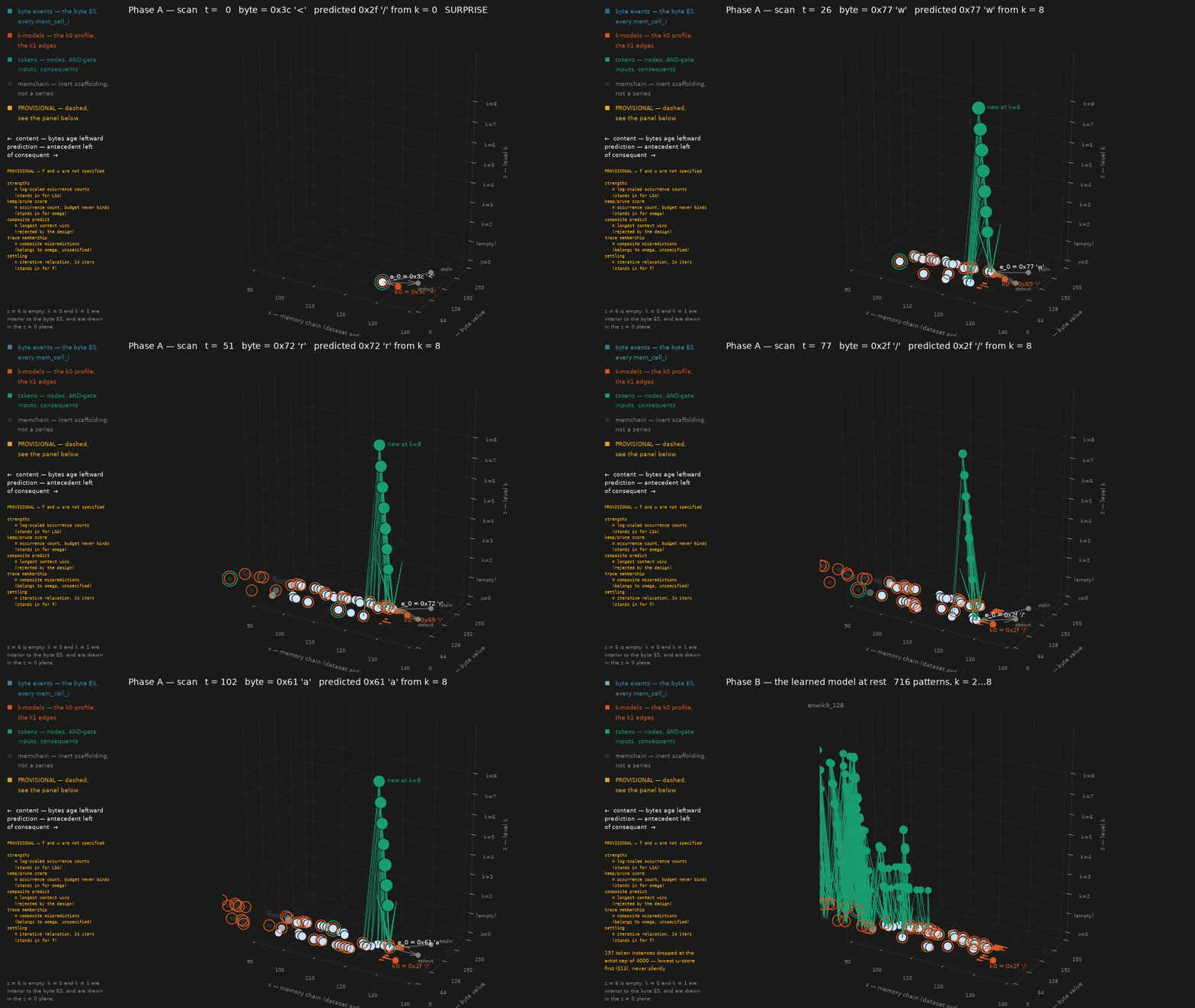
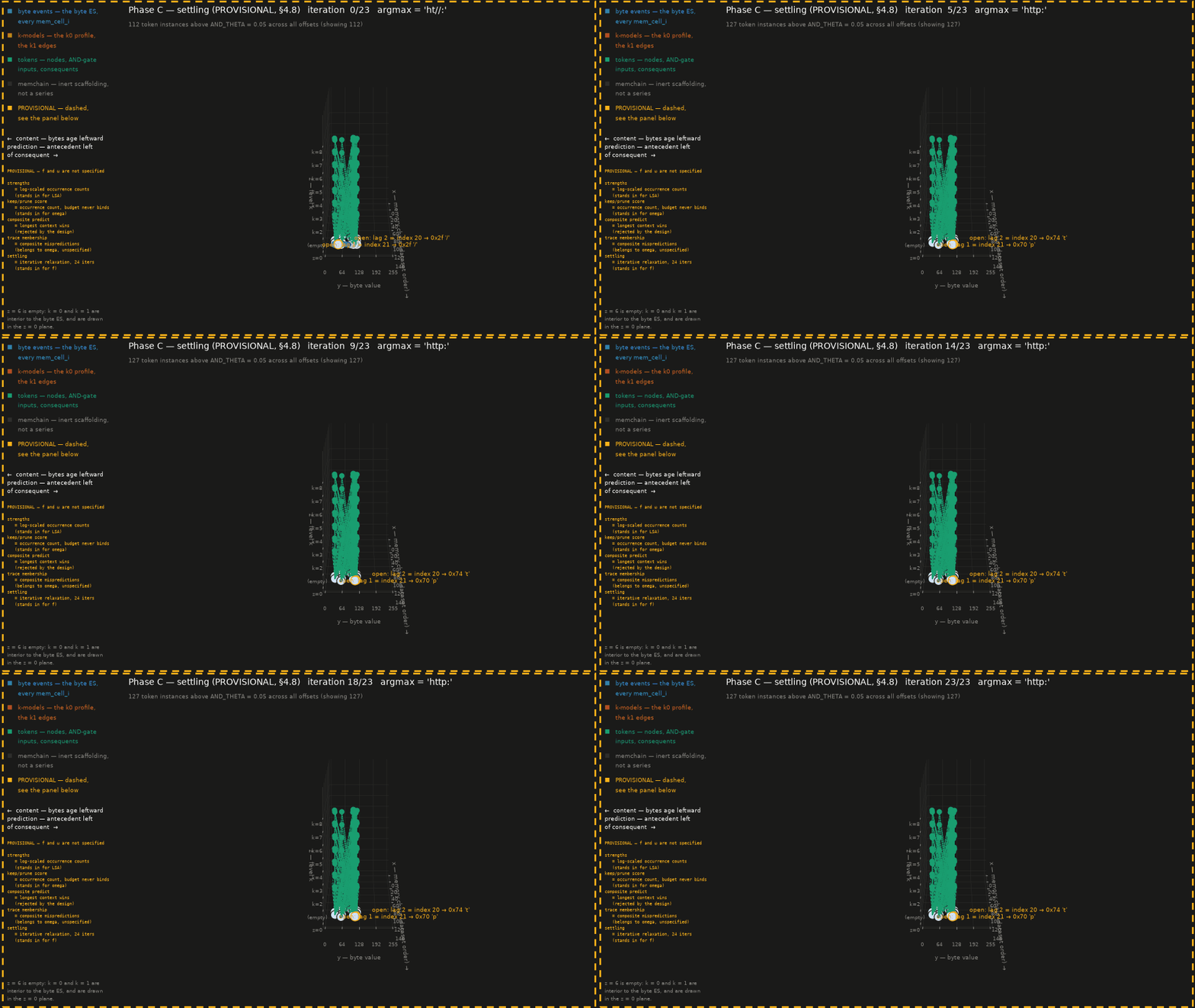
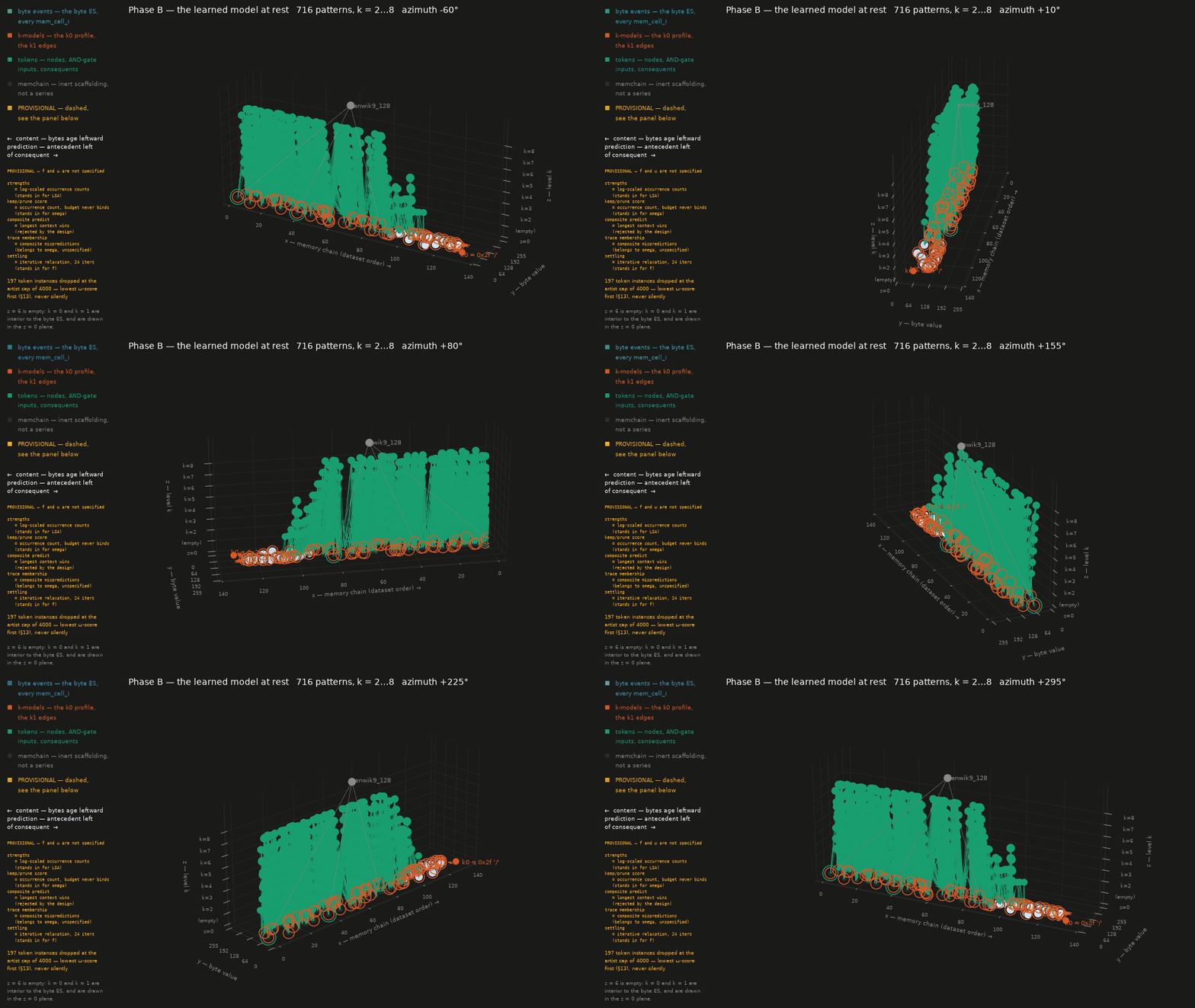
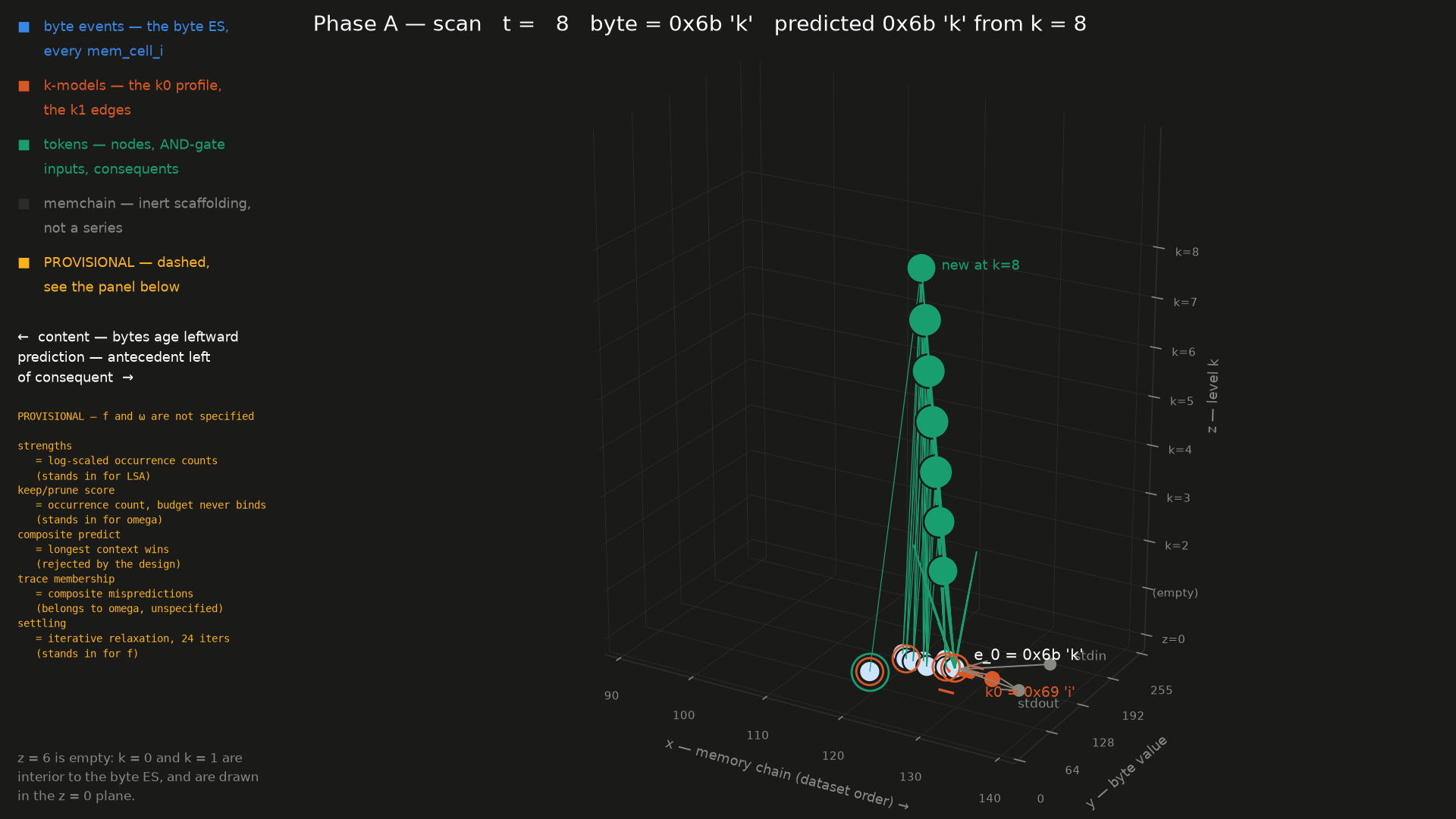
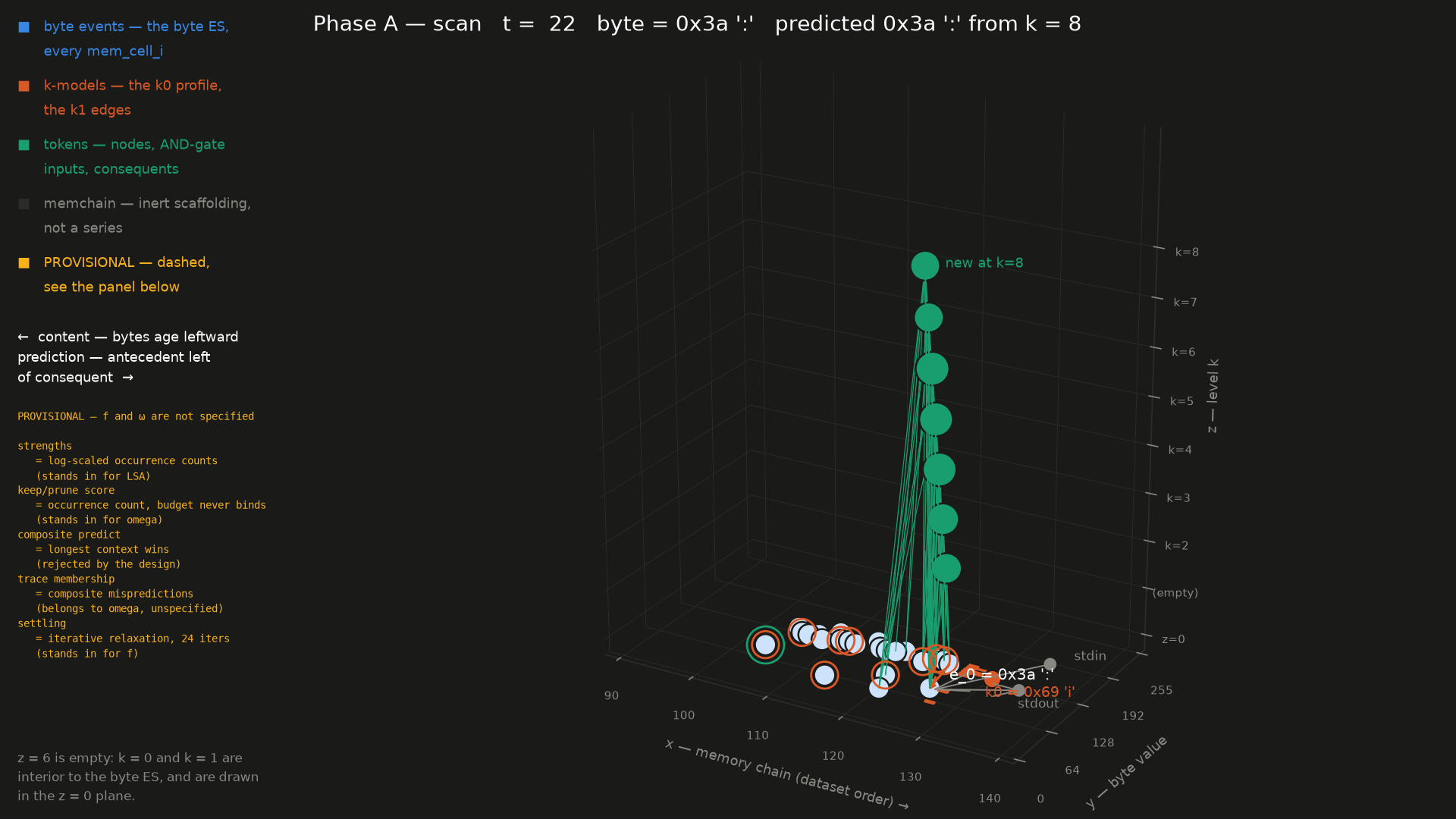
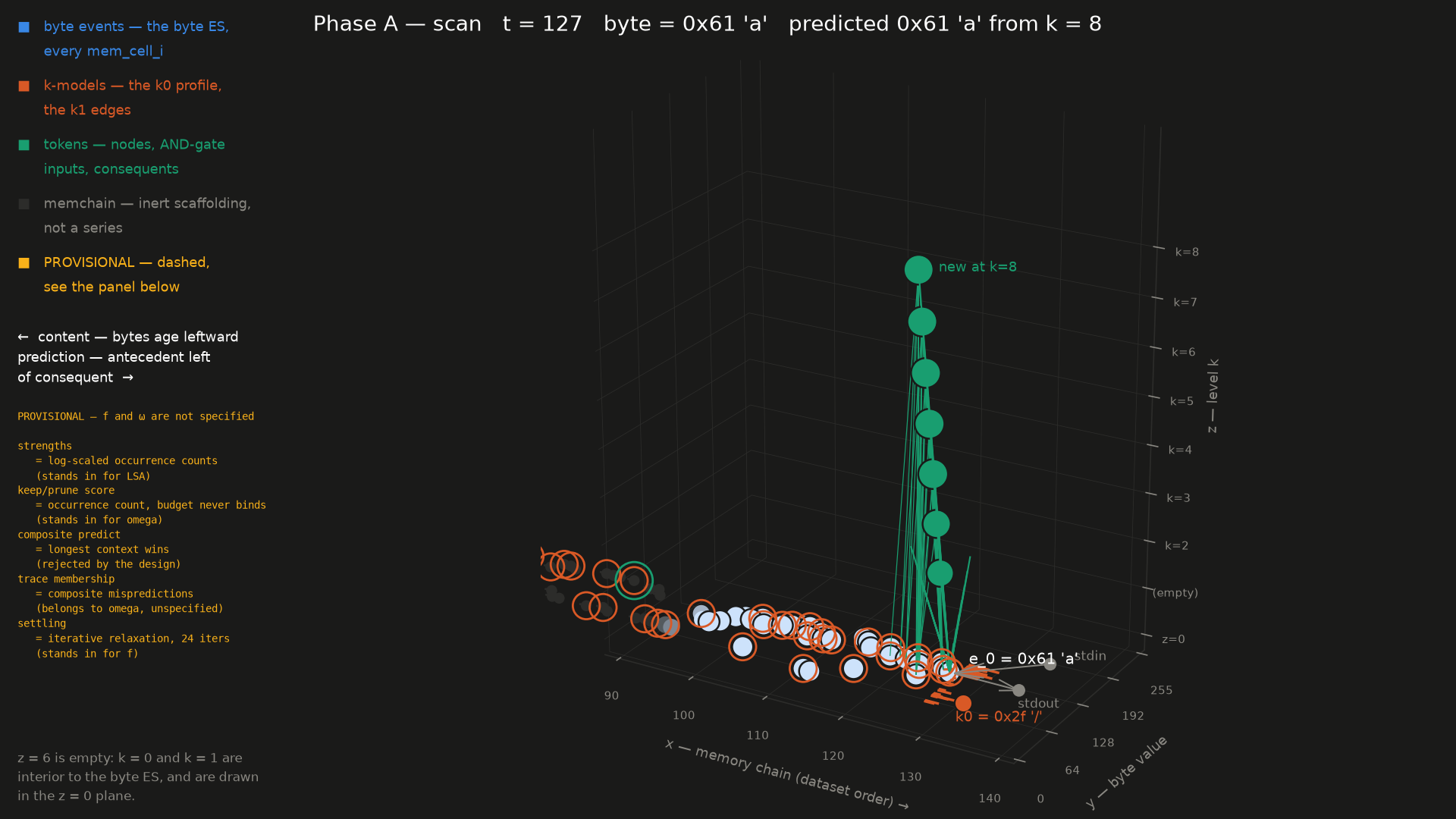
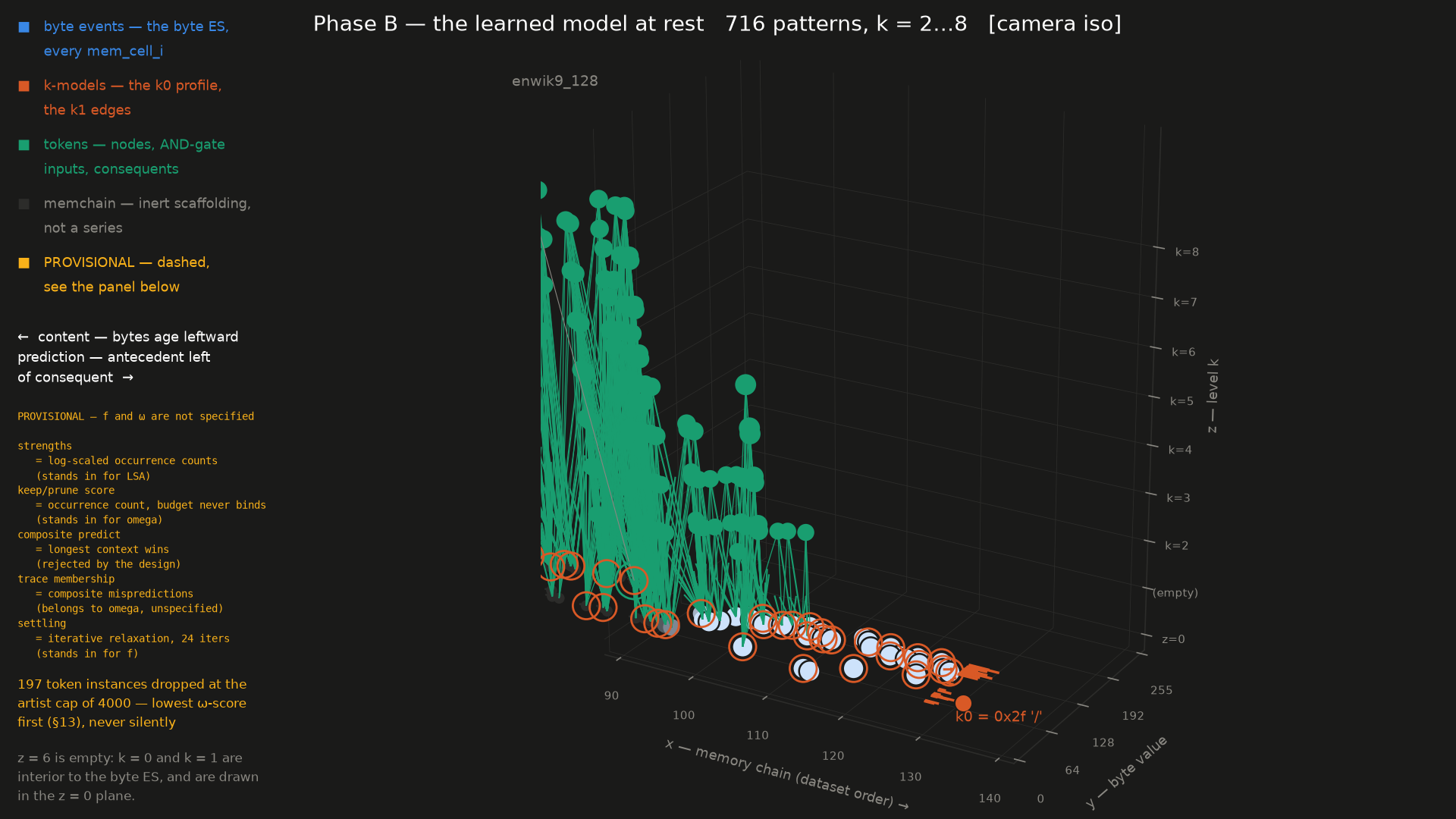
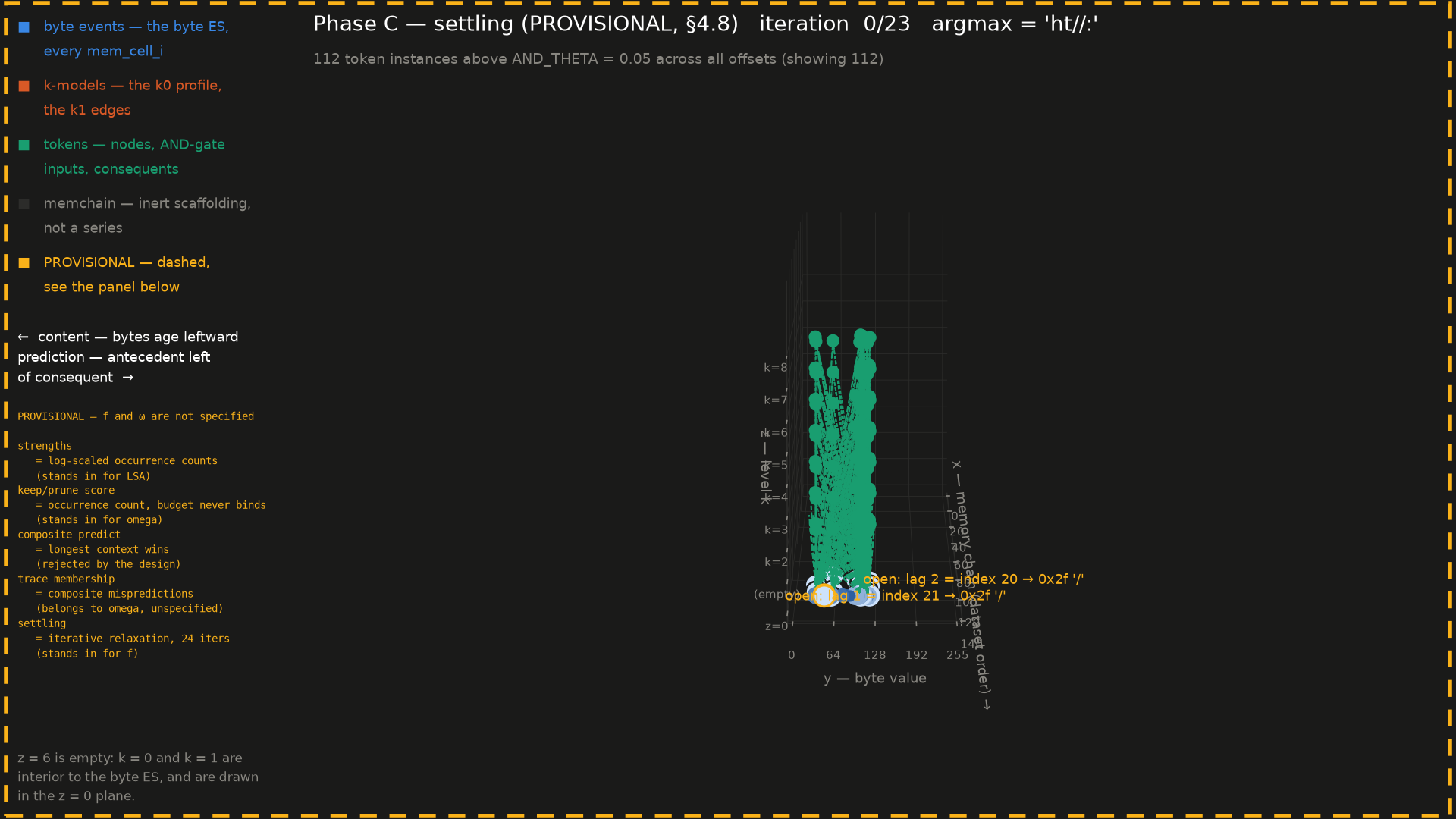
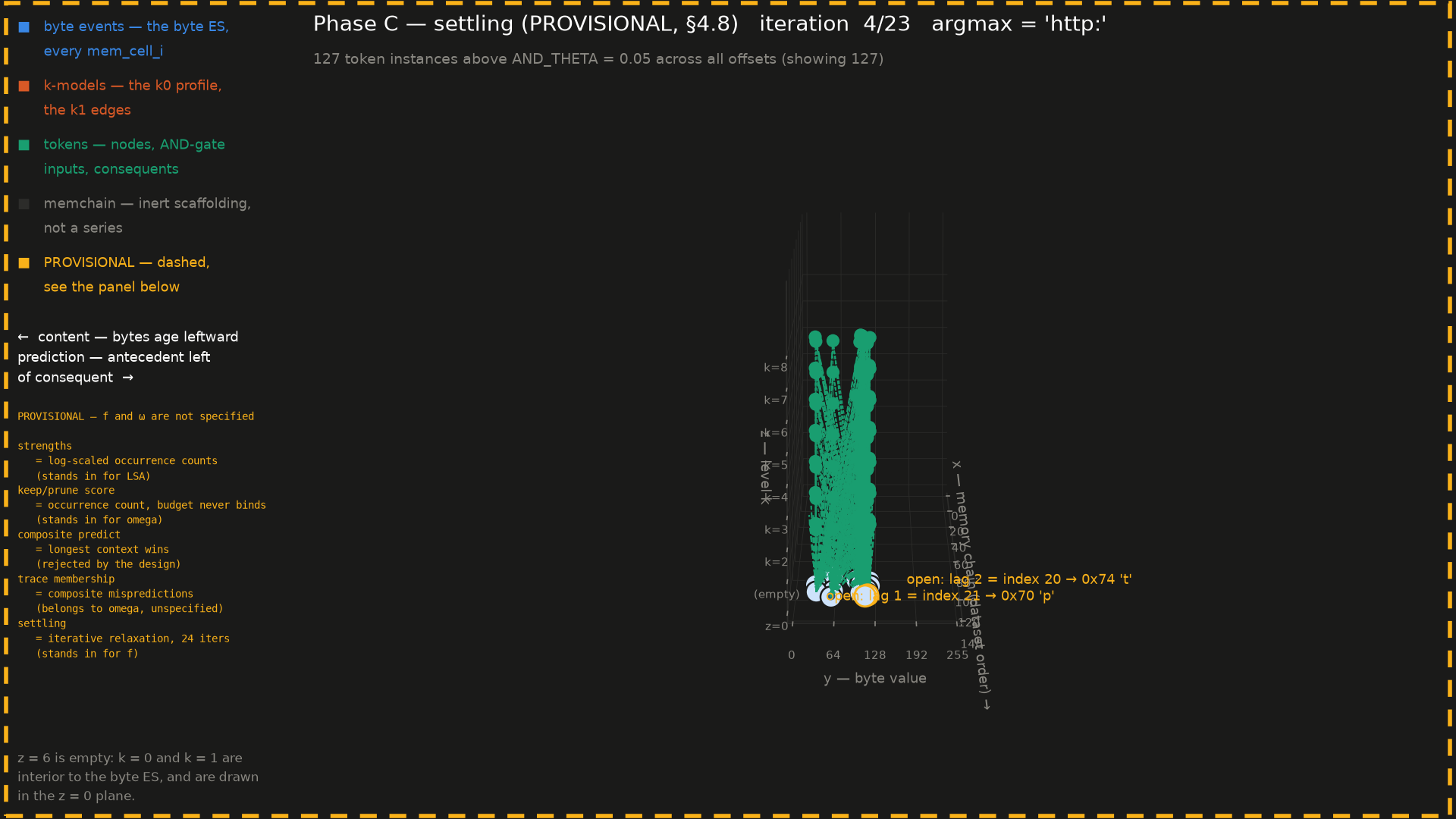
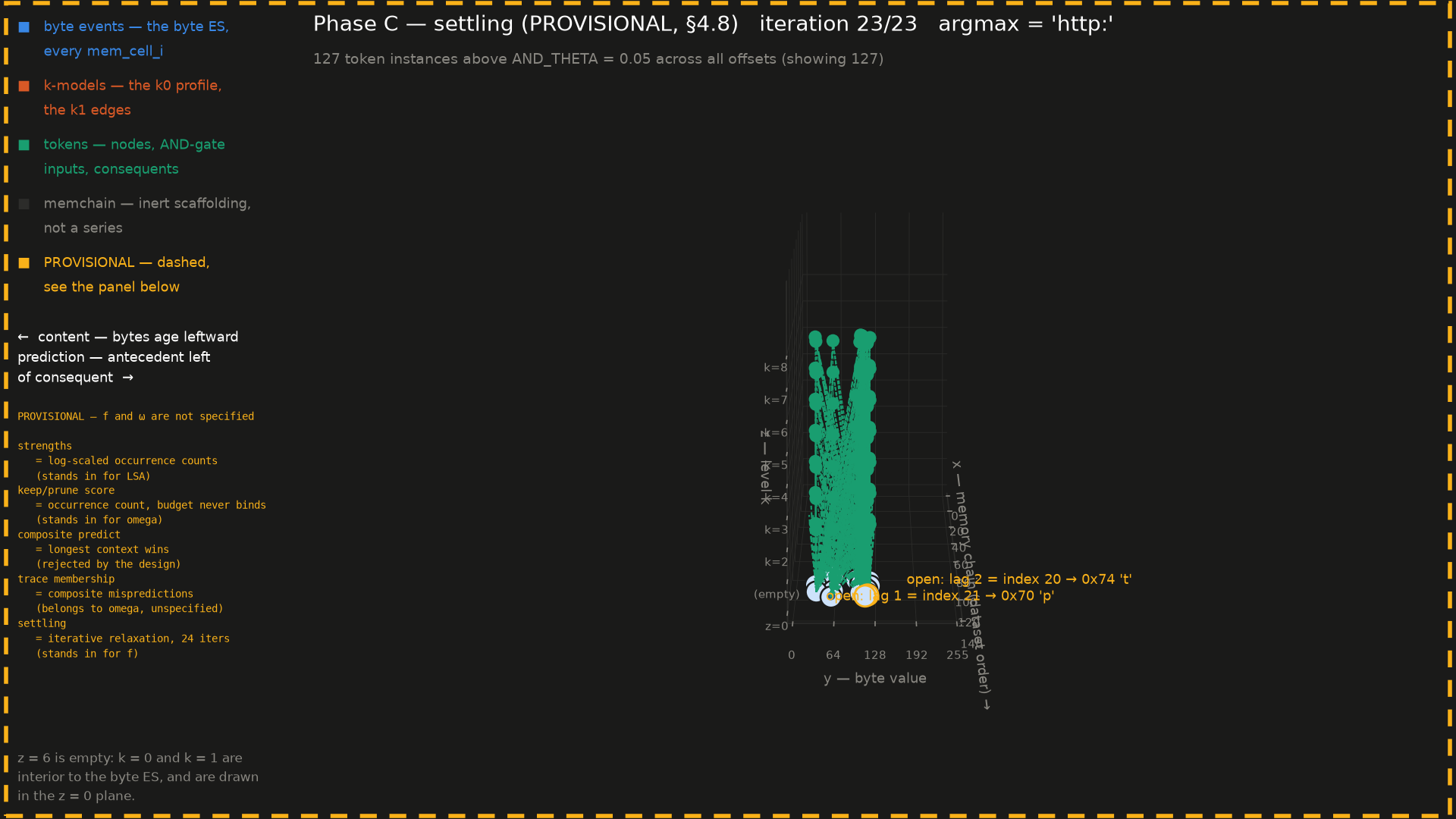
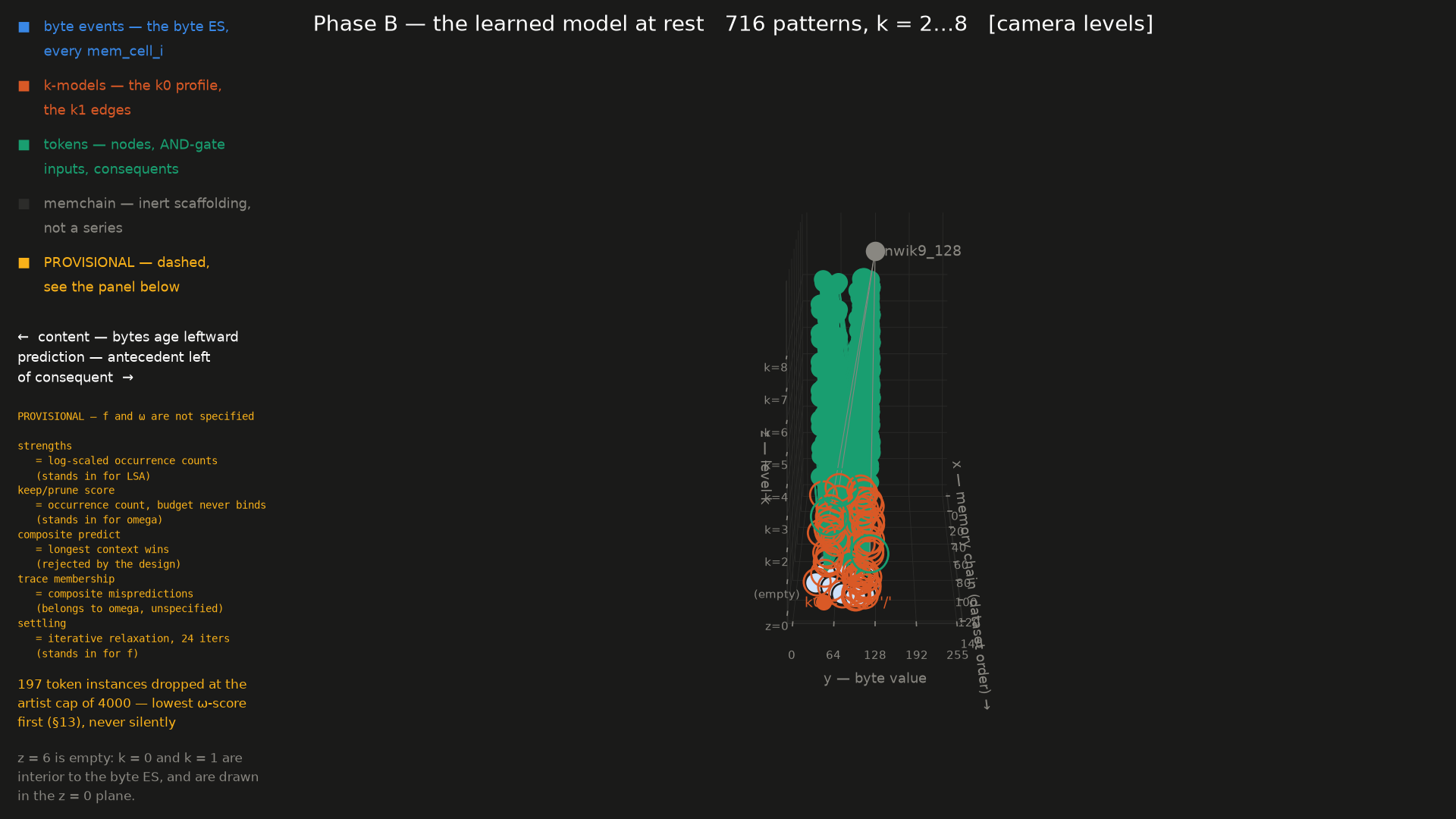
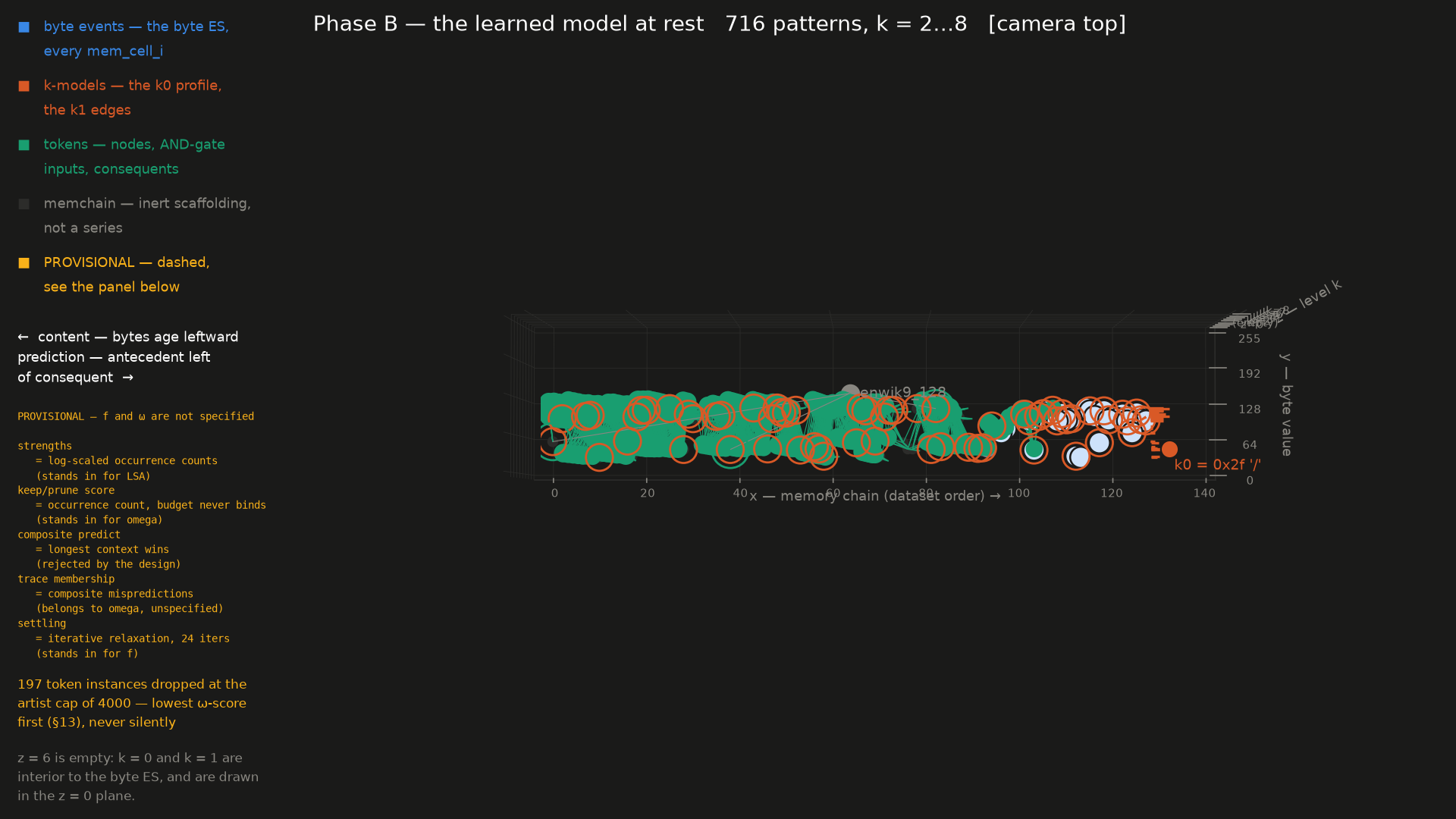
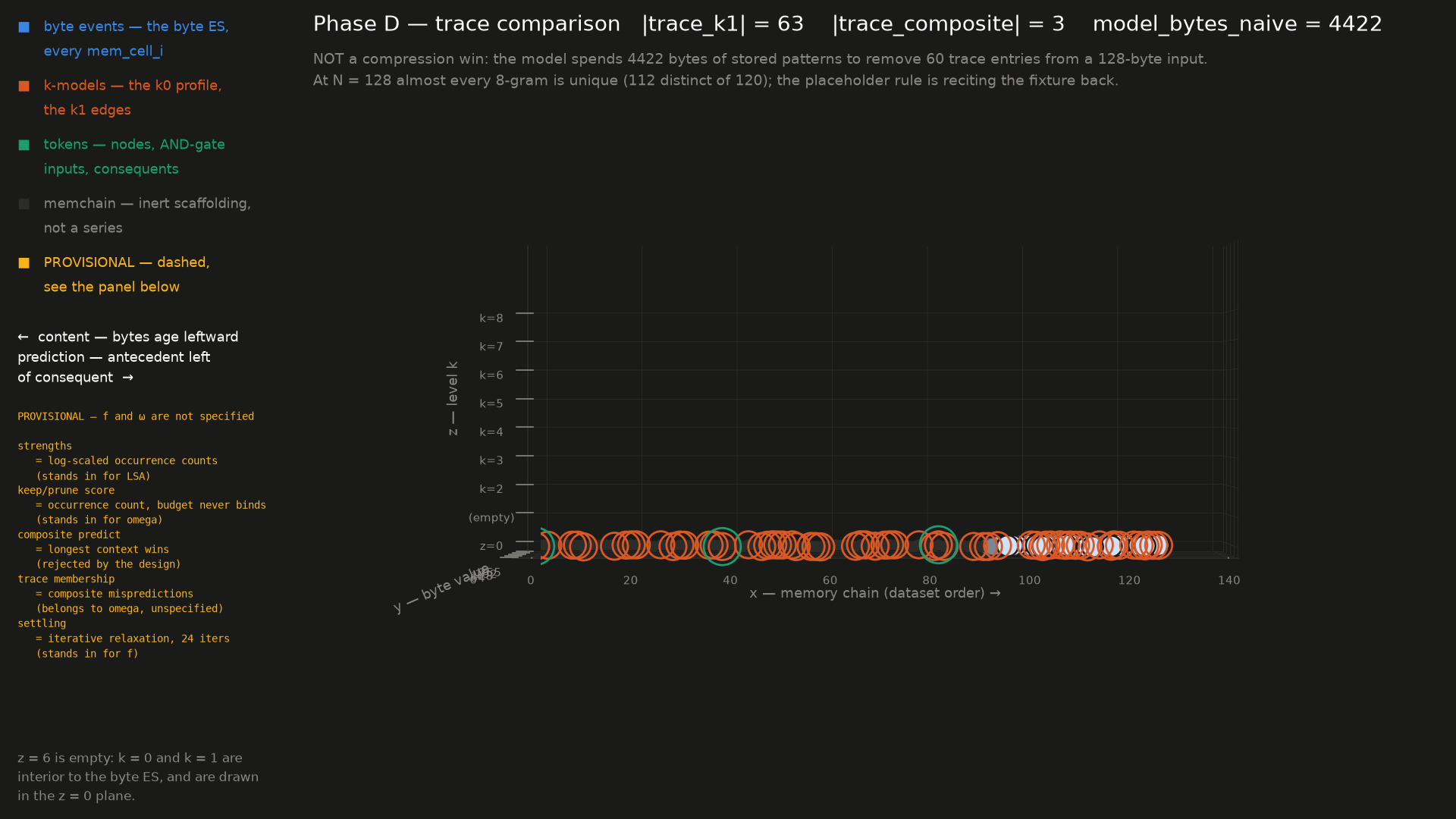
A 3-D rendering of the event spaces and patterns of the p8v2 P-program, run over a fixed 128-byte prefix of enwik9, with k = 8 and N = 128. Rendered from p8v2-viz-spec.md by p8v2-viz.py.
Open the viewer → Ten stills with captions, three animations, and stats.txt — one self-contained file with every asset inlined. About 22 MB, so give it a moment; it needs no server and no network once saved.http: worked example.| stats.txt | every figure the spec pins down, machine-checkable |
| p8v2-scan.gif | Phase A scan + Phase B held (6.6 MB) |
| p8v2-settle.gif | Phase C settling (1.0 MB) |
| p8v2-orbit.gif | Phase E orbit (3.9 MB) |
| still-01-first-window.png | t = 8, the first full k = 8 window |
| still-02-http.png | t = 22, the http: example being learned |
| still-03-scan-end.png | t = 127, the end of the scan |
| still-04-model.png | Phase B, camera iso |
| still-05-settle-00.png | Phase C iteration 0 |
| still-06-settle-04.png | Phase C iteration 4 |
| still-07-settle-23.png | Phase C iteration 23 |
| still-08-levels.png | Phase B, camera levels |
| still-09-top.png | Phase B, camera top |
| still-10-traces.png | Phase D, camera chain |
| light/ | the same ten stills on the light surface |
| frames/ | 128 scan + 24 settle + 72 orbit frames |
The renderer takes no arguments and writes everything to ./out/.
It needs the standard library, numpy and matplotlib, and nothing else — no
network, no corpus file, no configuration. Two runs produce an identical
stats.txt.
The 128-byte fixture was verified byte-for-byte against a real enwik9 before these figures were rendered, so the spec's caveat that its second half was reconstructed rather than copied is discharged.